Skip to content
10 Reasons Women Over 45 Feel Invisible — And the One Nobody Is Talking About | Arzavelle Journal
Women & Visibility  ·  Editorial
Women & Visibility

10 Reasons Women Over 45 Feel Invisible — And the One Nobody Is Talking About

The feeling is real. It's not your imagination. It's not vanity. And at least one of the reasons is something you can actually do something about.

A woman sitting with coffee in warm morning light, relaxed and self-possessed — editorial, natural

She arrived early. She stood at the counter. She waited.

Two younger bartenders were working the room. Neither looked at her. When her male friend walked in a few minutes later, one of them immediately walked over and asked him what he wanted.

"I could have stood there naked, screaming," she wrote afterward, "and still gone unnoticed."

You may not have that exact story. But you probably have a version of it.

The makeup counter where someone stepped past you to help the woman next to you. The meeting where you made a point and no one responded — and then a colleague made the same point ten minutes later and the room lit up. The conversation where you felt yourself start talking and watched, in real time, as the other person's eyes shifted slightly to the side.

"It's like I don't exist anymore… I feel utterly invisible compared to when I started, and it seemed to happen just overnight."

— r/Menopause

This is one of the most commonly described experiences among women in their 40s and 50s — and one of the least talked about out loud. Because it sounds like complaining. It sounds like vanity. It sounds like a woman who wants attention she shouldn't want.

It is none of those things.

What she's describing is real. It's documented. It's experienced by millions of women around the same age, in the same sudden way, and it is not about her worth or her relevance or whether she matters. Something shifted. The world's response shifted with it. And nobody gave her a map.

I've spent two years trying to understand why this happens — specifically, why it seems to happen so suddenly, often right around perimenopause, and why so many women describe it as feeling like they "disappeared overnight." What I found surprised me. And at least one part of it is something that's actually fixable.

Here are ten things I learned.

The women I kept talking to weren't describing a vanity project. They weren't asking to look 25 again. They were asking to look the way they feel — present, engaged, fully in the room. The outside stopped matching the inside. That is not the same as wanting to look younger. And it turns out it's not the same solution, either.

— E. Alvarez
A woman sitting alone in a café, observed through glass — present but unacknowledged

The feeling of invisibility after 45 is real — and it's not in your head.

The first thing to understand is that this isn't imagination or sensitivity or a midlife crisis. The experience of women becoming socially less visible in their late 40s and 50s is documented and measurable. A 2019 survey of women over 45 found that 69% of midlife women said they feel invisible to advertisers. A separate body of social psychology research has shown that perceived age directly affects how often people are looked at, greeted, engaged, and listened to in everyday public situations.

I work with women in this age group professionally, and the consistency of this description across clients, across backgrounds, across circumstances — it is one of the clearest signals in my work that something real is happening. What women are experiencing is not a distorted perception. It's a real shift in how the world is responding to them. The response changed. The woman didn't.

"Whenever I come across women our age, I make an effort to smile so they recognize my presence… it's an acknowledgement of being alive." — r/GenXWomen

That line — "an acknowledgement of being alive" — is not melodrama. It's a woman describing what it feels like to move through the world when the world has started looking past you. And it starts, for most women, somewhere between 45 and 55.

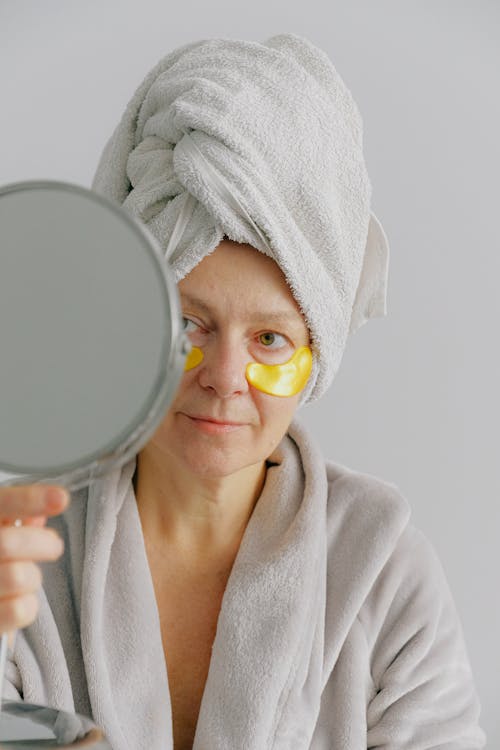
A middle-aged woman in a bathrobe looking quietly into a bathroom mirror, natural morning light

It happens suddenly — and the suddenness is not a coincidence.

The thing women describe over and over again is the speed of it. Not a gradual fade. A step-change. One year you were seen. The next year you weren't, and you couldn't point to exactly what had changed. This specific pattern — sudden rather than gradual — is one of the clearest signals that something hormonal is involved.

Perimenopause typically begins between 45 and 55 and can involve fairly rapid hormonal shifts over a compressed period of time. The changes that come with those shifts aren't just internal — they affect how a woman presents to the world. Energy, posture, skin quality, and a dozen other subtle visible signals shift in a short window. And the world, which was already not paying close enough attention, responds to the composite picture.

"At 51, I feel like I've turned into a tired, washed-out version of myself." — r/Menopause

She's describing an identity crisis through an appearance observation. That's not shallow — that's the exact mechanism. The outside stopped matching the inside. And nobody around her had the vocabulary to explain why.

A woman near a window, warmly lit, looking directly at the camera — present and self-assured

The world does respond differently to visible vitality — and that's worth understanding, not apologizing for.

There is a conversation that gets stuck every time this subject comes up: you shouldn't have to change how you look to be treated well. You are worthy as you are. Appearance shouldn't matter. All of that is true in principle. None of it is particularly useful to a woman standing at a counter waiting to be acknowledged.

The sociological reality — and this is consistent with what I see both in the research and in the room — is that human beings respond to visual cues of vitality, presence, and engagement, and they do so largely unconsciously. Skin that looks healthy and lit from within signals presence. Eyes that look rested signal engagement. A face that looks like it matches the energy behind it signals I am here, I am awake, I am fully in this room. When those signals fade, the world's response fades with them — not because she has less worth, but because the signals are quieter.

Understanding this is not capitulation. It's information. And information is what makes the difference between feeling helpless about it and knowing which part of it you can actually do something about.

"It has been an adjustment to realize how much more effort I need to put into things like makeup and hair to be 'seen.' But once I do I'm not invisible anymore." — r/AskWomenOver30

She found her way back to presence. She figured it out. Most women shouldn't have to figure this out alone — and the industry has not been honest about the specific, fixable piece of this that it could actually help with.

A contemplative mature woman, close portrait, soft natural light — thoughtful, not posed

One of the biggest contributors to the "invisible" look is something happening to your skin — and it has nothing to do with wrinkles.

This is the part nobody explains clearly — and, frankly, the part that took me the longest to find in the research, because the dermatology literature and the beauty industry aren't talking about it in the same language. When women describe looking "washed out," "flat," "tired no matter how much I sleep," or "like a less vivid version of myself" — they're describing something specific that happens to skin after hormonal shifts in the mid-40s. Not wrinkles. Something different.

Healthy, well-hydrated skin has a microscopic surface structure that catches light and scatters it outward in all directions — the diffused glow that photographs as "radiant" and reads in person as present, awake, vital. As estrogen levels shift, that surface layer changes. It doesn't disappear — it flattens. It absorbs more light than it reflects. The result is that the skin starts looking flatter, more matte, more tired — even when nothing else about a woman has changed.

"My face appears washed out and beige. The radiance is gone… I find myself piling on cream blush just to avoid looking lifeless."

— r/Menopause

She's not wrong about what she's seeing. And she's not imagining it. The light went out of her skin — and that visible change is one of the key drivers of the "invisible" signal the world picks up. It's not the only reason. But it's one of the most fixable ones.

I call it flat-light skin. The industry doesn't have a name for it. That's part of why it's taken this long for anything to actually address it.

A skincare product shelf with various serums and bottles on marble — warm, editorial

Every "brightening" product you've tried was solving a different woman's problem.

The skincare industry has two main "brightening" categories. Vitamin C serums, which reduce melanin and address dark spots and pigmentation. And exfoliating acids, which accelerate cell turnover to reveal fresher-looking skin. Both are legitimate skincare tools. Neither targets the flat-light problem.

If your glow disappeared because of sun damage or hyperpigmentation, vitamin C is exactly what you need. But if your glow disappeared because the surface structure that reflects light changed — not the color of the skin, but how the skin interacts with light — then a pigmentation product won't fix it. It's a different mechanism entirely.

"Did absolutely nothing for my skin. No glow, no difference, no smoothing." — Amazon review, popular brightening serum

She wasn't wrong about the product. It was probably doing exactly what it claimed. She just had a product aimed at a different woman's problem — and without anyone explaining the distinction, there was no way to know. The product category for flat-light skin barely exists yet. Which is why most women cycle through brightening products for years without finding an answer.

An amber glass serum dropper bottle catching warm light — ingredient-focused, editorial

If niacinamide broke you out or did nothing, the problem wasn't the ingredient.

Niacinamide is one of the most well-studied topical ingredients in dermatology — over 100 peer-reviewed studies document its effects on skin barrier function, texture, and tone. It's genuinely effective. Which is why so many women have tried it. And why so many women have a disappointing story about it.

The explanation is almost always concentration. Most products that advertise niacinamide contain less than 2% — a concentration too low to produce visible results. Some products go the opposite direction, formulating at 10–15% — high enough to cause flushing and breakouts in skin that has become reactive after 45. Both directions produce failure. Both lead women to conclude that niacinamide doesn't work for them.

"I thought for so long my skin just didn't like niacinamide… then realized the problem was not with the ingredient but the strength." — Amazon review

The clinical sweet spot for niacinamide — where it visibly supports barrier function and surface texture without triggering reactivity — is 5%. Not 2, not 15. Most products aren't there. The result is a generation of women who have written off one of the most relevant ingredients for their exact skin concern, because no one told them what to look for on the label.

A serene mature woman in soft, natural light — glowing skin, unhurried, fully herself

Restoring glow to flat-light skin requires something that works at the surface — not just underneath it.

Most serums are designed to penetrate — to deliver active ingredients into the deeper layers of the skin where the real structural work happens. That's the right approach for barrier repair, collagen support, and long-term texture change. It's not the right approach for the light-reflection problem, which lives at the very surface of the skin.

What creates the visible glow effect — the thing you can see from across the room — is a hydration film at the skin's outermost layer. Something that creates a soft, light-scattering surface rather than a deep-penetrating treatment. This is where watermelon-derived extract becomes relevant to the flat-light problem specifically. Watermelon rind is among the richest natural sources of L-citrulline, an amino acid that has been shown in peer-reviewed dermatological research to support the skin's surface moisture-retention capacity — the mechanism that governs how the outermost layer holds and scatters light. Unlike many actives designed to penetrate, citrulline's primary documented action is at that outermost layer. It works on the problem where the problem actually lives.

The difference between a "glow product" that gives you 30 minutes of shimmer and one that genuinely changes how you look all day is exactly this: shimmer reflects light as a concentrated beam. Surface hydration scatters it softly in every direction. One looks artificial. The other looks like your skin, just turned back up.

A woman examining her skin closely in a mirror, skincare routine, thoughtful expression

Your skin didn't get difficult. It got more specific. And those are completely different problems.

Women describe post-45 skin in a particular way: "suddenly sensitive," "reactive," "it hates everything now," "nothing absorbs." Dermatologists often confirm that hormonal changes make skin more sensitive and leave it at that — as if the prescription for sensitive skin is to accept a diminished version of your routine and expect less.

What's actually happening is more precise. As estrogen declines, the skin barrier becomes more permeable. A more permeable barrier does two things: it makes skin more reactive to ingredient overload — which is why a 12-product ritual that worked at 38 might break you out at 52 — and it reduces the skin's own capacity to maintain surface hydration. The flat-light effect gets worse. The reactivity increases. Everything feels like a trap.

"One moment it's fine, the next your moisturizer feels like a burn." — r/45PlusSkincare

The answer isn't a stripped-down routine of nothing. And it isn't throwing more actives at a barrier that's already overwhelmed. It's finding the precise few ingredients that support that barrier without overloading it — at the right concentrations, in a lightweight, non-occlusive base that doesn't pile on. More isn't better. Precise is better.

A woman applying a serum while looking in a mirror — morning ritual, calm, editorial feel

One visible result in the first 60 seconds changes the entire 8-week equation.

The ingredients that genuinely address flat-light skin over time — niacinamide for barrier and texture, the right surface actives for the light-reflection layer — require consistent use over 4 to 8 weeks to produce their structural results. That's the honest timeline. Most people quit at week two.

They quit because there was no proof. Nothing to confirm that the product was doing anything. And for a woman who has already spent hundreds of dollars on products that "did absolutely nothing," invisible progress isn't enough reason to continue. The math turns negative and she stops — four weeks before the result would have been visible.

The solution to this problem is a formula that delivers two distinct effects at once: something you can see on day one — a visible, immediate surface layer that changes how your skin looks in the mirror right now — and something working underneath over weeks on the structural problem. The first result earns the trust that makes the second one possible. Without both, the long game never gets played.

"I've ditched makeup altogether — even my mother remarked on my radiant glow." — r/AskWomenOver50

That's what happens when the right combination of ingredients — immediate surface effect and long-game structural change — are in the same formula, and someone actually finishes the bottle because day one gave them a reason to.

A confident, elegantly dressed woman, direct gaze — present, self-possessed, fully seen

You're not trying to look younger. You're trying to look present again. And the beauty industry has been selling you the wrong project.

There is a distinction that most of the beauty and wellness industry consistently ignores — and it shows every time a campaign aimed at women over 45 manages to both insult and bore them simultaneously. They keep selling anti-aging, when the actual ask is something more specific and more honest: I want to look the way I feel.

"I don't want to look 20 or 30. I don't mind the few wrinkles I have. Your face tells a story and I don't want to lose my story or look like anyone else but me."

— r/SkincareAddiction

She doesn't want erasure. She doesn't want to pretend the last thirty years didn't happen. She accepts her face — she actually values her face. What she cannot accept is an outside that has gone quiet in a way that doesn't match who she is. She is still vivid. She is still fully here. Her skin just stopped showing it.

That's not an anti-aging project. That's a presence project. A visibility project. And the gap between those two framings is enormous — because one involves buying products designed for a woman you don't want to be, and one involves finding something built for exactly who you already are.

"It's actually so freeing being able to choose when and how you are seen." — r/AskWomenOver30

That's the right promise. Not younger. Not unrecognizable. Not "look 20 again." Seen — on your own terms. Present by choice. And for the piece of this that lives in your skin — the flat-light problem that dimmed the signal — that is, genuinely, fixable.

After Two Years of Research

The glow you had wasn't about being young.
It was about a surface your skin used to build on its own.

Once I understood that flat-light skin was an optical, surface-level problem — not an aging problem — the question became: does anything address this specifically? Not "brightening" in the pigmentation sense. Not a glow serum with shimmer particles. Something built for the light-reflection mechanism. Niacinamide at the precise clinical concentration for barrier work. A watermelon-derived complex for the immediate surface layer. Nothing to pile on top of a reactive barrier. Lightweight enough to wear under makeup without pilling.

I found it. And the first application — the first 60 seconds — told me I was in the right place. Not shimmer. Not gloss. That soft, multi-directional scatter. The signal that says: I'm here. I'm present. Look again.

If you recognize any of what I've described in this piece — the sudden flat look, the tired skin that doesn't match how alive you feel, the products that pilled or broke you out or simply did nothing — I think it's worth seeing what I found.

See What I Found → Arzavelle.com